If you are hiring a salesperson to sell into government, stop looking for a closer. Start looking for someone who can survive 18 months of procurement, navigate a buying committee they will never fully see, and care more about the agency’s mandate than their own quota. Traditional corporate sales training does not produce this person. You have to know what you are looking for.
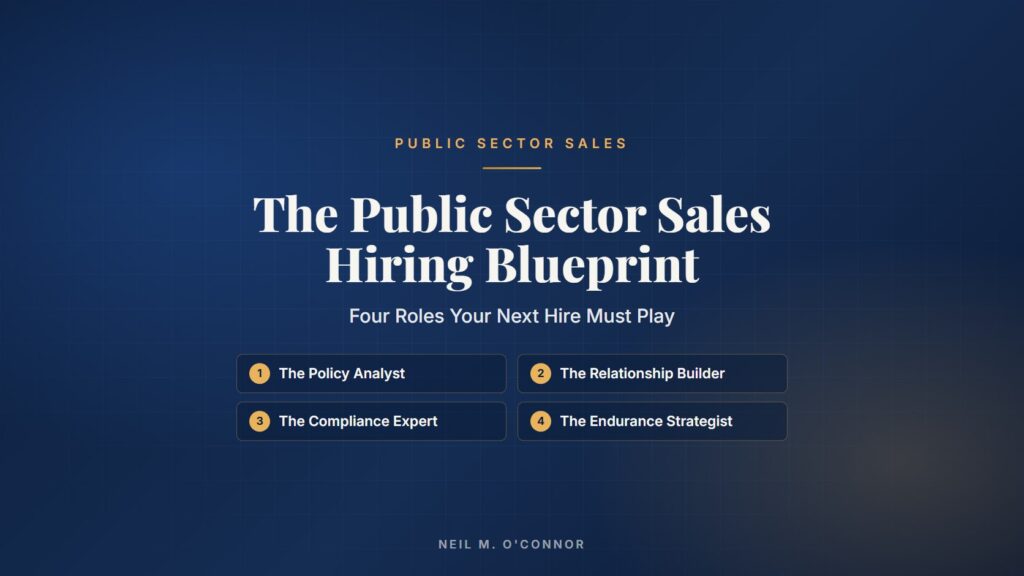
In Chapter 4 of Strategic Revenue Enablement, I ask a question most organizations skip: “What is salesmanship?” In the private sector, getting that answer wrong is expensive. In the public sector, it is fatal. Your next public sector hire needs to operate as four distinct professionals at once.
1. The Policy Analyst
Government buyers do not respond to pressure tactics, artificial urgency, or competitive takeout plays. Discount deadlines do not work. Friday close incentives do not work. What works is an advisor who understands the agency’s institutional problems better than the agency expected an outside vendor to understand them.
When you interview for this role, do not ask candidates if they are consultative sellers. Every candidate will say yes. Instead, ask them to walk you through a deal where they had to understand a piece of legislation or a policy framework before they could position their solution. If they cannot give you a specific example with the policy name attached, they haven’t done this work.
2. The Relationship Builder
In commercial B2B, you find a champion and build outward. In government, the buying committee is a formal structure with procurement officers, technical evaluators, policy advisors, and elected officials or their staff. Each one evaluates your solution against different criteria. The person with the title is rarely the person with the influence.
Look for candidates who can describe how they mapped a government buying committee without relying on an org chart. Ask them who the real decision-maker was and how they found that person. If the answer starts with “I asked my champion,” they are running a private-sector playbook in a public-sector environment.
3. The Compliance Expert
In commercial sales, legal and procurement slow deals down. In government, compliance IS the deal. Security clearances, accessibility standards, data sovereignty requirements, official language obligations, indigenous procurement targets. A candidate who treats these obstacles to work around will be disqualified before their pitch deck hits the projector.
The behavioral indicator here is straightforward. Ask candidates how compliance requirements shaped their solution design, not how they overcame compliance hurdles. The language matters. An experienced public sector seller builds compliance into the architecture. An inexperienced one fights it.
4. The Endurance Strategist
Government procurement can run 12 to 24 months and beyond. RFP timelines are rigid. Budget cycles dictate when money is available, not when your prospect is ready to buy. A change in government can kill a deal that was 90% closed. In the private sector, a slipped deal moves to the next quarter, and the budget carries over. In the public sector, the budget evaporates. The deal is not delayed. It is dead.
Ask candidates to describe a time a political shift threatened a major deal. How did they see it coming? What did they do? Experienced candidates will have already forecast against the election cycle. They will know which budget line funded their deal and when that line expires. The inexperienced ones will tell you the deal “fell through due to circumstances beyond their control.”
Building Your Interview Rubric
Genuine care for the customer’s mission. What I call the Give a Shit factor in my book is the foundation underneath all four of these roles. But you cannot assess it by asking candidates if they care. They are professional salespeople. They will tell you exactly what you want to hear. Assess it through the specificity of their answers. A candidate who references the agency’s mandate, names the legislation, and describes how citizens benefit from the solution shows you care through preparation, not performance.
Most sales hiring processes produce none of these archetypes. That is the gap.